|
| The right bicep muscle. |
Have you ever heard of fractals? You know the pattern in a pattern in a pattern? Like a fern or the Mandelbrot set?
 |
| Examples of Fractals. |
Well a muscle reminds me a lot of a fractal in that if you zoom in on a muscle starting at the naked eye, the structure seems to repeat itself. First with a bundle of muscle fibers, then with the muscle fiber itself which is a bundle of myofibrils. Within the myofibrils live Actin and Myosin chains which interact to cause muscle contractions, aka when your muscle shortens itself or "flexes". (I'm not going to get into the specifics of muscle contraction in this post)
 |
| Diagram of the structure of a muscle. |
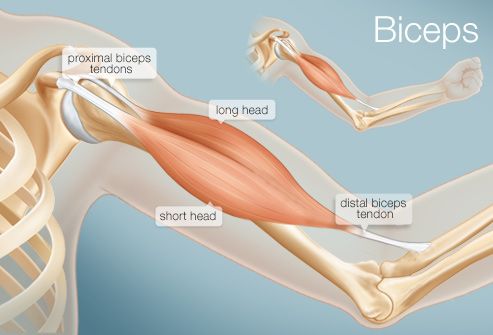 |
| The anatomy of the bicep. |
As you can see the upper part of the bicep muscle attaches via tendons to the shoulder while the lower portion of the bicep muscle attaches to the lower arm, below the elbow. When the muscle contracts, or shortens, the elbow acts as a pivot point and the lower arm is brought closer to the upper arm. Take your arm right now and hold it out straight in front of you with your palm facing upwards. If you want to lift your hand to touch your face, you are contracting your bicep muscle, the more you contract it, the closer your hand is to your face. Pretty awesome stuff! Of course the bicep is not the only muscle in the human body, in fact there are between 640-850 muscles in the human body! Amazing! These muscles range in type from voluntary (the skeletal muscles we use to walk around) to involuntary (the visceral muscles which control your inner organs) and cardiac (your heart).
 |
| Diagram of the muscles in the human body. |
The main type of muscle that I want to focus on are the voluntary or skeletal muscles. You know, the ones that help use pick those weights up and put them back down. Some muscles have a counterpart muscle that acts in opposition to it. An example of this is the hamstring and quads (blue/purple in the diagram above). When the hamstring is flexed, the quads are stretched and when the quads are flexed, the hamstring is flexed. Think of these opposing muscles as balancing one another to make sure our skeleton is not pulled to far in any one direction.
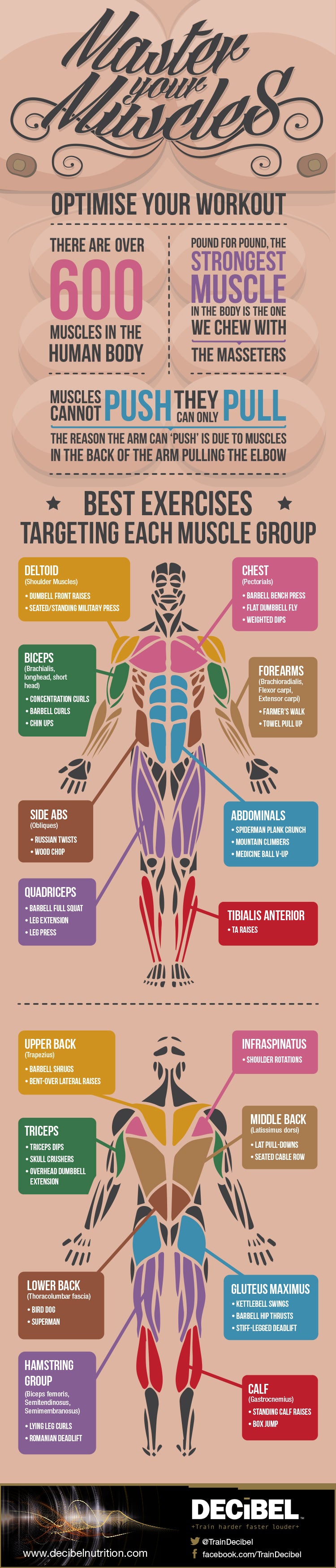
The exercises that we do to get "in shape" can either use multiple muscle groups at once or focus on one muscle group at a time. The diagram below lists the muscle group and several exercises that are associated with those muscles. Next time you are sore and you are wondering what on earth you were doing that made that specific muscle hurt so bad, check out this infographic and try and figure out which exercise it was! For example, my quads get sore if I do a lot of squats. I hope you have enjoyed this mini lesson on what a muscle is!